
Most rare 2 pound coins are perceived exclusively as a means of payment in daily currency circulation.
A number of releases demonstrate market behavior characteristic of scarce assets, significantly exceeding their face value on the secondary market.
The value of such specimens is determined by objective mintage factors, the presence of production errors, and the physical preservation of the metal.
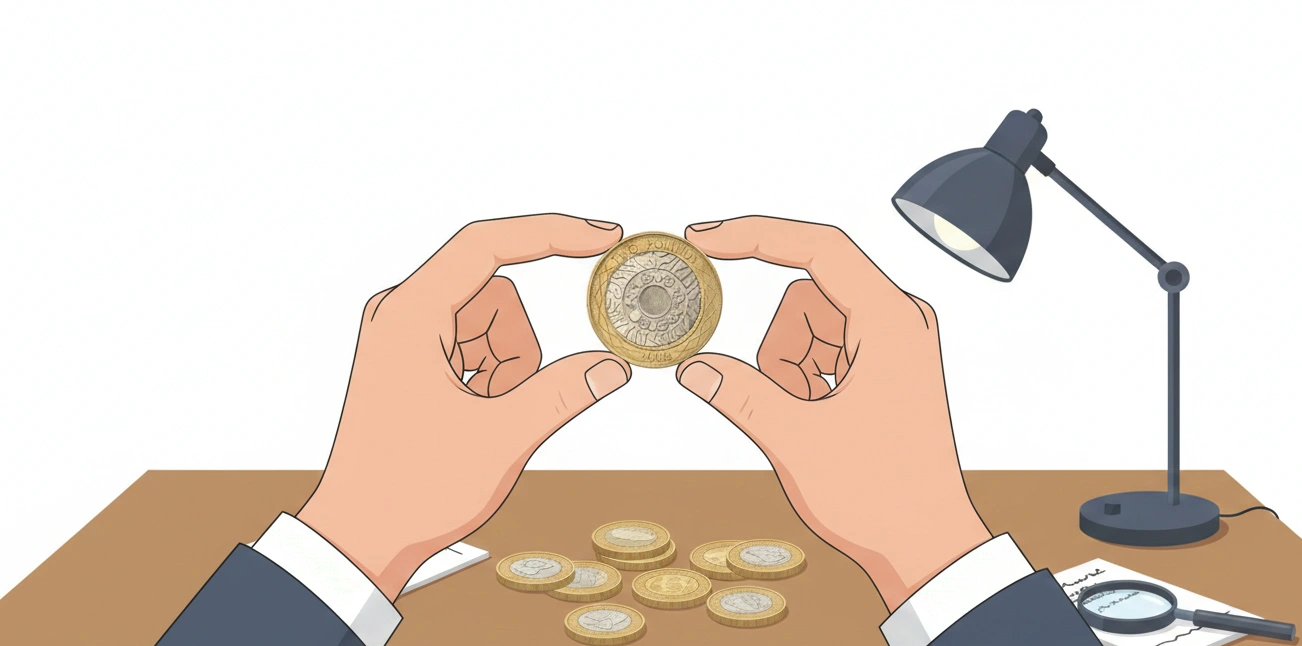
The modern bi-metallic £2 coin was introduced into circulation in 1998 following successful testing of technological processes.
The product’s construction involves using two different alloys joined under high pressure during the minting process.
- Outer Ring: Nickel-brass (76% copper, 20% zinc, 4% nickel)
- Central Disc: Cupro-nickel (75% copper, 25% nickel)
- Mass: 12.0 grams
- Diameter: 28.4 millimeters
- Thickness: 2.5 millimeters
Using two metals simultaneously increases the coin’s security against counterfeiting, creating unique visual characteristics of the edge and the disc joint boundaries.
The market value of UK coins correlates directly with official mintage data provided by the Royal Mint.
Most commemorative releases have mintages ranging from 2 to 5 million units, ensuring their moderate availability.
Special status is held by releases whose production volume did not exceed the 1 million mark.
| Release Name | Year | Mintage | Rarity Category |
| Commonwealth Games (Northern Ireland) | 2002 | 485,500 | Extremely Rare |
| Commonwealth Games (Wales) | 2002 | 588,500 | Rare |
| Commonwealth Games (Scotland) | 2002 | 771,750 | Rare |
| Commonwealth Games (England) | 2002 | 650,500 | Rare |
| Olympic Handover (Rio to Tokyo) | 2016 | 635,000 | High Demand |
The 2002 Commonwealth Games (Northern Ireland) release remains the leader in scarcity for over two decades.
Economic Dynamics and Auction Value
Prices for rare £2 coins show steady growth outpacing the inflationary indicators of the British economy.
Analysis of trading platforms and specialized auctions reveals patterns in value changes depending on the coin’s condition.
For the Commonwealth Games (Northern Ireland) release, the following price indicators are recorded:
- Circulated condition: £35 – £50
- Uncirculated condition (in sets): £60 – £85
- Proof condition (silver or gold): £200+
Statistics for the period from 2018 to 2024 show an average annual value increase of 8-12% for this release, provided the physical condition is maintained.
The Issue of Mint Errors
Technological failures during the production of bi-metallic coins create unique specimens whose price can exceed the value of standard rare mintages by dozens of times.
The most valuable error is recognized as using the wrong metal or disrupting the process of joining the disc and ring.
Confirmed types of defects include:
- Missing edge lettering
- Wrong planchet (wrong metal)
- Die rotation (misalignment of obverse and reverse)
- Off-centre core (displacement of the central disc relative to the ring)
In 2021, a £2 specimen with a missing copper-nickel center was realized at auction for an amount exceeding £1,200.
Such anomalies occur extremely rarely given the multi-stage quality control at the production facility in Llantrisant.
The 1997 Coin
The first bi-metallic coins are dated 1997, although the mass introduction into circulation took place later.
A common misconception exists regarding the extreme rarity of coins with this date.
In reality, the 1997 mintage totaled over 13 million units, making them common objects for circulation.
Investment interest is represented only by Brilliant Uncirculated specimens from the first minting batches.
Price Change Dynamics in Percentage Terms
The £2 coin market demonstrates cyclic activity associated with the release of new commemorative series.
The release of a new coin series by the Royal Mint usually provokes a short-term price increase of 15-20% for old releases of a similar theme.
During the following 12 months, a downward price correction of 5-7% is observed as supply stabilizes.
The long-term trend remains positive for coins with mintages below 1 million units.

Professional Inspection
Identifying a coin’s value requires a detailed analysis of the micro-relief and the condition of the edge.
- Verifying the release date on the obverse under the monarch’s portrait
- Measuring the clarity of the edge lettering, which is a mandatory design element
- Analyzing the joint of the two metals for gaps or traces of manual interference
- Evaluating the preservation of the mint luster on the central disc fields
- Checking the reverse image against the official catalog to exclude counterfeits
List of Market Value Reduction Factors
Certain damages exist making a coin unsuitable for investment collecting.
Reasons for a price drop of 50% or more:
- Deep scratches on the monarch’s portrait
- Traces of cleaning with aggressive chemical compounds
- Oxidation of the brass ring with the appearance of dark spots
- Mechanical deformations of the rim from falling on a hard surface
- Presence of foreign inclusions in the metal joint area
The Royal Mint regularly releases series dedicated to historical figures or events.
For example, the 2016 William Shakespeare series includes three different coins: Tragedies, Comedies, and Histories.
The mintage of each totals about 4-5 million units, limiting their investment potential in the short term.
However, full Uncirculated sets show a stable value growth of 4% per year due to the removal of coins into private collections.
Investment Risks and Bi-Metal Storage
The complex composition of £2 coins imposes restrictions on their maintenance conditions.
The brass ring is extremely sensitive to air humidity, quickly losing its original luster and becoming covered with patina.
To preserve the grade, the following is necessary:
- Storage in inert plastic capsules
- Using specialized numismatic trays with velvet lining
- Room humidity control at a level no higher than 45%
- Minimizing contact with open air
Data Sources and Analysis Methodology
This article is based on official Royal Mint reports and archives of completed trades from Spink and Noonans auction houses.
Mintage statistics are current as of the latest UK Treasury publication.
The appraisal methodology excludes subjective factors, relying exclusively on confirmed transaction amounts.
The provided data allows for an objective assessment of the potential of £2 coins as a numismatic asset.